
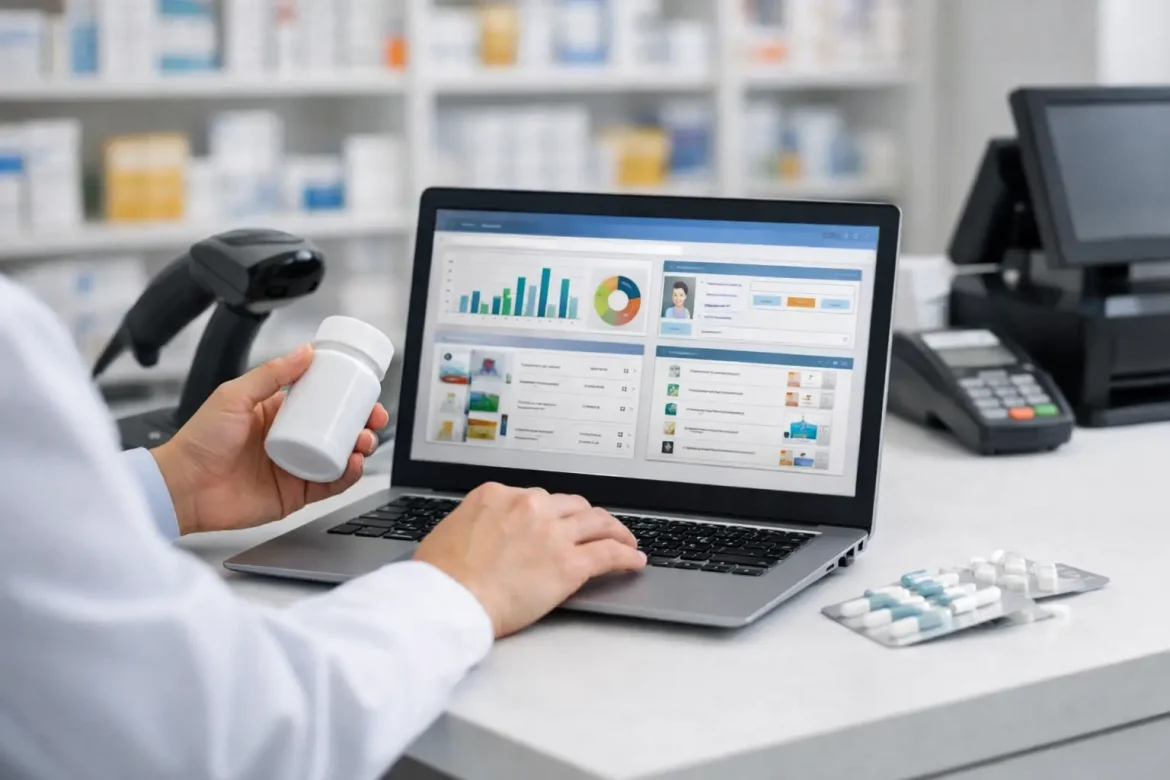
A missed reorder, a claim rejection that keeps cycling back, a front-end promotion no one can track, and a patient waiting too long at the counter – this is where retail pharmacy management software stops being an IT purchase and becomes an operating decision. For pharmacy owners and managers, the right system shapes daily speed, inventory accuracy, staff workload, and the quality of patient interaction.
The market is crowded with platforms that promise efficiency, visibility, and better control. Those promises are not meaningless, but they are often presented as if every pharmacy has the same priorities. They do not. An independent neighborhood pharmacy, a high-volume urban location, and a pharmacy expanding clinical services will not judge software by the same standards.
What retail pharmacy management software should actually solve
At its best, retail pharmacy management software brings together dispensing operations, inventory control, pricing oversight, claims processing, reporting, and customer management in a way that reduces friction across the business. That sounds straightforward. In practice, many pharmacies still operate with disconnected workflows, partial visibility into stock movement, and reports that arrive too late to support decisions.
A useful system should help answer operational questions quickly. Which categories are tying up too much capital on the shelf? Where are margins shrinking? Which staff tasks are consuming time without adding value? Which recurring patients are at risk of dropping off because refills are not being actively managed? If the software cannot support these decisions, it may process transactions without improving management.
This distinction matters because many pharmacies do not fail from one major breakdown. They lose performance gradually through small inefficiencies – excess stock, untracked shrink, delayed follow-up, weak category analysis, and too much dependence on manual workarounds.
Core functions that matter in a pharmacy setting
Dispensing remains the operational center, so speed and accuracy at the prescription level are non-negotiable. Staff should be able to move from patient record to prescription processing to payment and counseling support without unnecessary clicks or duplicate entry. A system that looks feature-rich but slows the counter experience can create more pressure than it removes.
Inventory control is usually the next major test. Good pharmacy inventory is not just about knowing what is on the shelf. It is about reorder logic, supplier coordination, expiry monitoring, substitution handling, and category-level visibility. Pharmacies with weak inventory discipline often have cash flow problems hiding inside apparently acceptable sales performance.
Reporting deserves more attention than it usually gets during software selection. Owners often ask whether the system includes reports, when the more relevant question is whether the reports support action. Sales by category, gross margin trends, reimbursement pressure, basket composition, promotional performance, and dead stock analysis should be accessible without needing outside technical support every time a management question arises.
Customer and communication functions are increasingly relevant as well. Refill reminders, loyalty tracking where appropriate, service notifications, and patient segmentation can support retention and front-end growth. But these tools only help if they fit the pharmacy’s service model and regulatory obligations. More communication features do not automatically mean better communication.
How to evaluate retail pharmacy management software
The safest mistake in software buying is choosing the system with the longest feature list. The most expensive mistake is choosing one that does not match your workflow. A better approach starts with mapping the pharmacy’s pressure points before looking at vendors.
If prescription volume is high but profitability is tightening, reporting, reimbursement visibility, and labor efficiency may matter more than marketing features. If the pharmacy is trying to grow OTC sales and patient engagement, then merchandising data, loyalty tools, and communication workflows may carry more weight. If the operation is scaling across multiple locations, centralized visibility and standardization become critical.
This is also where pharmacy owners should involve the people who will actually use the system. Pharmacists, technicians, front-of-store staff, and management often see different problems. Owners may focus on reporting and margin. Staff may focus on speed, usability, and error prevention. Both perspectives are valid, and the system needs to support both.
A strong vendor demonstration should reflect your real operating scenarios. Ask to see a refill workflow, a reimbursement exception, an out-of-stock substitution, a return, a promotion setup, and an inventory discrepancy investigation. Generic demos tend to show smooth paths. Pharmacies need to understand how the software performs when daily operations become messy, which they often do.
Integration is where many projects succeed or fail
Software rarely operates alone. It may need to connect with POS systems, accounting tools, wholesaler ordering platforms, CRM functions, e-commerce channels, automation equipment, and payer-related workflows. Integration is not a technical detail to leave until the end of the conversation. It is often the reason implementation becomes delayed, costly, or disappointing.
Even when integrations exist, pharmacies should ask how data moves between systems, how often it syncs, who supports the connection, and what happens when one part fails. A platform can look modern on paper and still create manual reconciliation work behind the scenes.
This becomes especially relevant for pharmacies pursuing omnichannel models or broader service delivery. If online reservations, click-and-collect, health service bookings, or targeted communications are part of the growth plan, the management system should support that direction rather than require separate workarounds.
The trade-off between customization and simplicity
Most pharmacy managers want software that fits their operation. That is reasonable. But customization has a cost. Highly tailored systems may align closely with current workflows while becoming harder to update, support, or scale later. On the other hand, more standardized platforms may require the pharmacy to adjust some processes, which can feel uncomfortable but sometimes leads to better discipline.
There is no universal right answer here. A complex pharmacy with specialized service lines may need more configurability. A smaller operation with limited internal IT capacity may benefit from a cleaner, simpler system that staff can learn quickly and use consistently.
The key question is whether the software helps the pharmacy improve how it works, not just preserve every existing habit. Some workflows deserve to be protected. Others are simply old workarounds that technology should replace.
Implementation is a management project, not a software event
Many pharmacies underestimate the organizational side of software adoption. Data migration, staff training, process redesign, supplier setup, user permissions, and reporting configuration all affect whether the system delivers value. If implementation is rushed, the pharmacy may carry bad data and old habits into a new platform.
Training should be role-specific. Pharmacists, technicians, and managers do not need the same level of access or the same reporting focus. Short, practical training tied to everyday scenarios usually works better than one long technical session. Follow-up support also matters because the real questions often appear after go-live, not before.
Pharmacy leadership has a role here. If owners position the system as an administrative burden, staff will treat it that way. If they frame it as a tool for reducing stress, improving accuracy, and supporting smarter decisions, adoption tends to be stronger.
Cost should be measured beyond the subscription fee
The visible price of retail pharmacy management software is only part of the investment. Pharmacies should also consider implementation costs, hardware needs, integration fees, training time, support quality, downtime risk, and the internal time required to manage change.
At the same time, judging software only by price can be shortsighted. A lower-cost platform that weakens reporting, slows workflows, or limits scalability may cost more over time through labor inefficiency and lost opportunities. A more expensive system is not automatically better, but it should be evaluated against measurable operational gains.
Reasonable ROI questions include whether the software can reduce stockholding costs, shorten transaction times, improve claim resolution, support stronger category decisions, or increase patient retention. Those are business outcomes, not technical features.
What pharmacy leaders should ask before deciding
Before signing with any vendor, pharmacy leaders should be clear on three issues. First, what problems are we trying to solve now? Second, what capabilities will we need in the next three to five years? Third, how much change can the organization realistically absorb in the next implementation cycle?
Those questions help prevent a common mismatch: buying for an ideal future while ignoring present operational constraints, or buying only for current needs and limiting growth. The best decisions usually come from balancing immediate operational relief with realistic strategic planning.
For professional audiences following management and modernization themes, including readers of platforms such as Pharmacy management & COMMUNICATION, this topic sits at the center of a broader shift. Pharmacy is being asked to operate with greater efficiency, clearer differentiation, and stronger service value while maintaining healthcare credibility. Software alone will not deliver that shift, but the wrong system can certainly hold it back.
The right choice is usually the one that helps your team work with fewer delays, better visibility, and more confidence at the counter and behind it. That is not a technology ambition. It is a business discipline with direct consequences for growth, patient experience, and long-term resilience.