

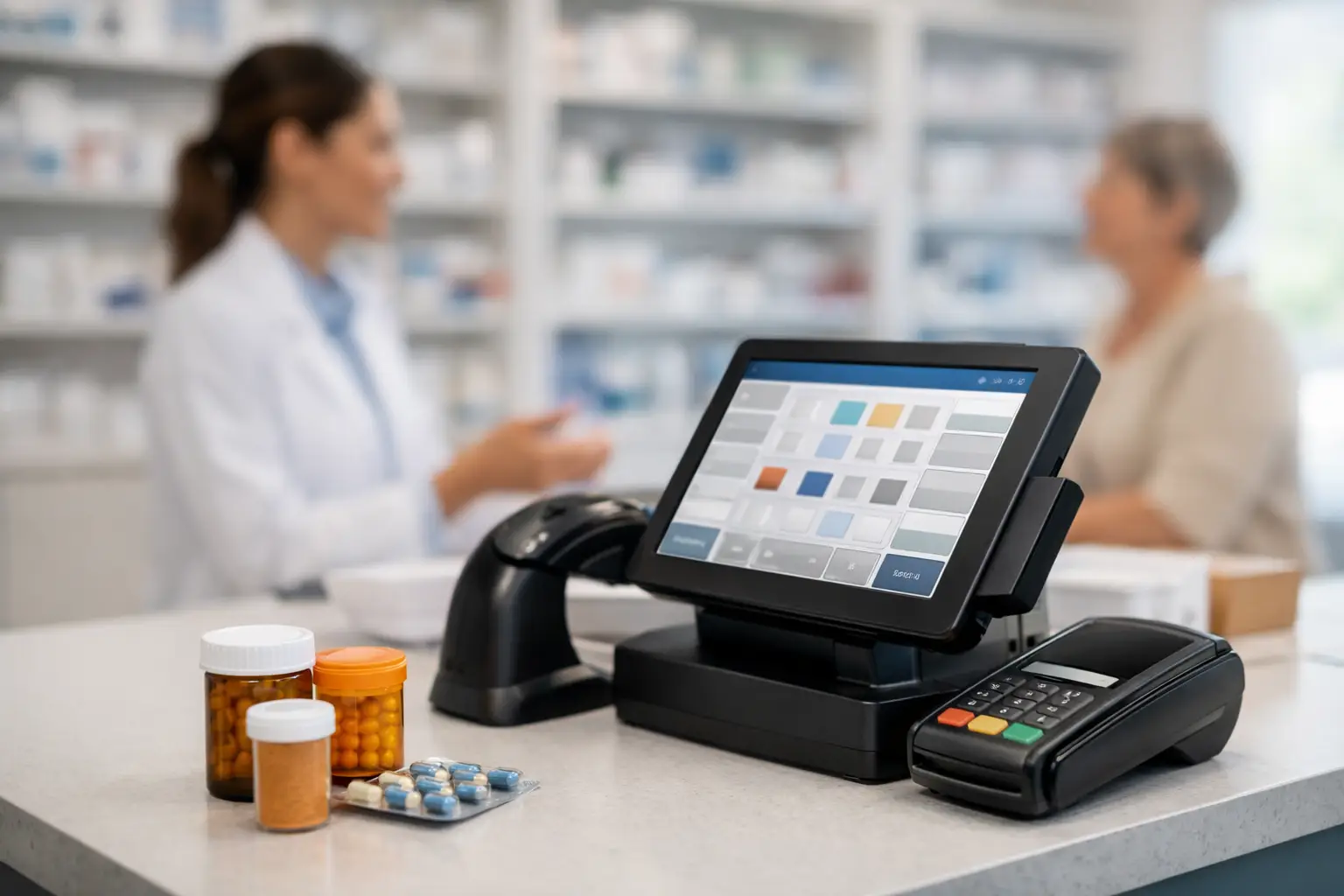
At the counter, the wrong system reveals itself fast. A prescription takes too many clicks, a loyalty discount misfires, stock data lags behind reality, and staff start creating workarounds instead of following process. That is why a pharmacy point of sale review should never be treated as a simple software comparison. For pharmacy owners and managers, it is an operational decision that affects speed, margin, compliance, staff training, and the patient experience.
In pharmacy, point of sale technology sits at the intersection of healthcare service and retail execution. It has to process transactions accurately, support regulated workflows, connect with inventory logic, and help the front end perform commercially. A generic retail POS may look attractive on price, but pharmacies operate with different pressures. They need tighter control, clearer audit trails, and better visibility into categories that influence profitability beyond prescription volume.
What a pharmacy point of sale review should actually measure
Too many evaluations focus on screen design, headline features, or vendor demos that look polished in a conference room. In practice, the right review starts with your own store model. An independent community pharmacy, a high-volume urban location, and a multi-store group will not rank the same priorities in the same way.
A serious pharmacy point of sale review should examine how the system performs under everyday pressure. That means prescription pickup peaks, partial fills, returns, controlled product procedures, staff handoffs, front-end promotions, and end-of-day reconciliation. If a system works only when the workflow is clean and predictable, it is not a strong pharmacy system.
The most useful question is not whether a POS has a feature. It is whether that feature reduces friction without creating a new problem elsewhere. A promotion engine that is powerful but difficult for staff to use can slow checkout. Detailed reporting is valuable, but only if managers can act on it quickly. Integration sounds impressive, but poor data synchronization can produce inventory errors that weaken trust across the team.
Core areas to assess in a pharmacy point of sale review
Workflow speed at the counter
Counter efficiency is still the first test. Staff should be able to move between prescription activity, OTC recommendations, patient questions, and payment with minimal switching and confusion. Every extra screen and every manual override has a labor cost. In high-traffic stores, those seconds add up into queue length, stress, and missed selling opportunities.
Look closely at how the system handles split transactions, insurance-related exceptions where relevant, suspended sales, returns, age-restricted products, and mixed baskets with prescription and retail items. The best systems shorten common tasks rather than simply digitizing them.
Inventory accuracy and category control
For many pharmacy businesses, stock is where margin quietly improves or deteriorates. Your POS should do more than register a sale. It should help maintain reliable stock movement data, support replenishment decisions, identify slow movers, and show category performance with enough detail to guide merchandising.
This matters especially in non-prescription categories such as dermocosmetics, supplements, wellness, and seasonal health products. A pharmacy may be clinically respected yet underperform commercially because it lacks visibility into attachment sales, basket composition, and category rotation. A capable POS helps managers understand what sells, what stalls, and what deserves shelf space.
Reporting that supports decisions
Reporting is often oversold and underused. Pharmacies do not need endless dashboards. They need meaningful reports that answer practical management questions. Which staff shifts produce higher front-end conversion? Which product categories are growing but discount-heavy? Which promotions increase basket size instead of simply reducing margin?
Good reporting should also distinguish between financial visibility and operational visibility. Sales totals are not enough. Managers need transaction patterns, refund behavior, peak-hour performance, and stock-related signals. If extracting this information requires vendor support every time, the system may be technically capable but managerially weak.
Compliance and control
Pharmacies operate in a stricter environment than general retail. That does not always mean the same legal requirements in every market, but it does mean stronger expectations around traceability, permissions, product handling, and record integrity. Your POS should support role-based access, reliable logs, and clear exception management.
This is one of the areas where cheaper platforms often fall short. A low entry price can hide risk if the system lacks proper controls for refunds, manual price changes, voids, and sensitive product categories. Owners should ask not only what staff can do, but what the system prevents them from doing without authorization.
Integration with the wider pharmacy operation
A POS no longer stands alone. It may need to connect with pharmacy management software, e-commerce tools, loyalty platforms, accounting, purchasing, labeling, CRM functions, and communication tools. The value of integration is obvious, but it comes with a trade-off. More connections can create more dependency points.
For that reason, integration quality matters more than integration quantity. Ask how often data syncs, how errors are flagged, who owns issue resolution, and what happens when one connected platform fails. A connected ecosystem is useful only when it remains manageable.
Where many pharmacies misjudge POS selection
One common mistake is buying for the present transaction volume only. Owners choose a system that works for today’s store but not for tomorrow’s service mix. If you plan to expand vaccination services, online ordering, private label ranges, or loyalty-driven front-end growth, the POS should support that direction from the outset.
Another mistake is underestimating implementation. Even a strong platform can disappoint if product mapping, staff permissions, training, and data migration are weak. In many cases, pharmacies blame the software when the real failure was rollout discipline. This is why vendor support should be reviewed as seriously as the product itself.
A third issue is assuming that familiar equals effective. Staff may prefer a legacy system because they know its shortcuts, but that does not mean it supports modern pharmacy management. Comfort can hide inefficiency. At the same time, replacing a known system with a feature-rich platform that overwhelms the team is also a risk. The right choice is often the one that balances operational improvement with realistic adoption.
Questions owners should ask vendors before deciding
The most revealing conversations happen after the sales presentation. Ask vendors how long typical implementation takes for a pharmacy of your size. Ask what data is migrated and what is not. Ask how promotions are configured, how returns are controlled, and how reporting can be customized by role.
You should also ask what support looks like during trading hours, how updates are managed, and whether pharmacy-specific references can speak to real outcomes. A vendor that understands pharmacy will speak about workflow, stock discipline, compliance, and commercial performance in the same conversation. If the discussion stays too general, the fit may be weak.
It is also worth asking for scenario-based demonstrations. Do not ask only for a product tour. Ask the vendor to process a prescription pickup, apply a targeted loyalty offer, handle a return, check stock, and produce a category report. Realistic scenarios expose friction much faster than polished demos.
The commercial case for a better POS
A POS upgrade is often justified on efficiency, but its commercial effect can be just as important. Better visibility into category performance can improve assortment decisions. Faster checkout can preserve service quality at busy times. Cleaner promotion controls can protect margin. More accurate stock data can reduce both missed sales and excess inventory.
This is particularly relevant in pharmacies trying to strengthen front-end performance without compromising professional identity. The system should help staff recommend appropriately, process confidently, and support a store model that combines healthcare credibility with retail discipline. That balance is where modern pharmacy management increasingly competes.
For readers of PHARMACY management & COMMUNICATION, this is not a minor technology purchase. It is part of the wider modernization agenda shaping pharmacy operations. The best systems support not only transactions but better managerial decisions.
Final view on any pharmacy point of sale review
The best POS is not the one with the longest feature list. It is the one that fits your pharmacy’s workflow, strengthens control, gives management usable visibility, and remains practical for staff at the busiest point in the day. When you review systems through that lens, the decision becomes less about software and more about the kind of pharmacy business you are building.