

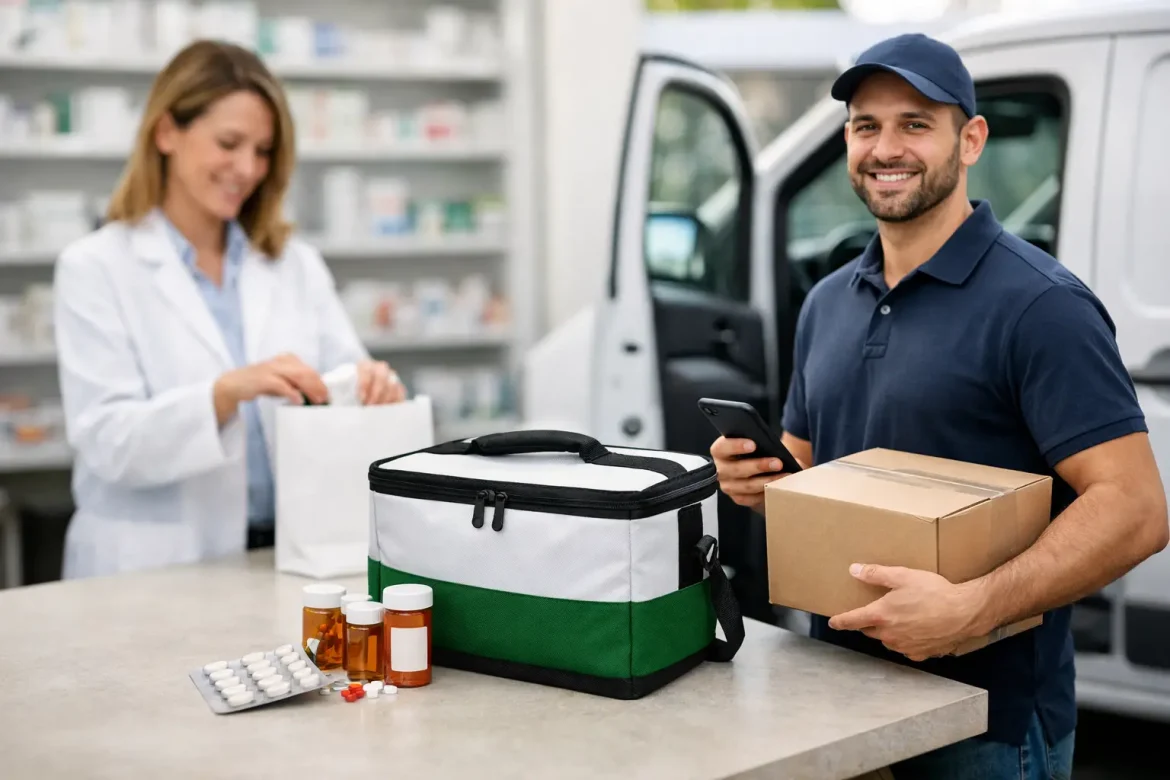
A pharmacy delivery service setup can look simple from the sidewalk – a driver, a few bags, a promise to deliver by evening. Inside the operation, it is a different story. Delivery touches prescription workflow, patient privacy, staffing, dispatching, reimbursement pressure, and brand reputation all at once. For pharmacy owners and managers, the real question is not whether delivery sounds attractive. It is whether the service can be built in a way that protects margins, supports patient care, and holds up on a busy Monday.
Why pharmacy delivery service setup is now an operational issue
Many pharmacies added delivery reactively, often in response to patient demand, local competition, or public health disruption. What began as a convenience quickly became an expectation. That shift matters because expectations are expensive when they are not supported by process.
Delivery can strengthen adherence, improve access for older adults and patients with mobility constraints, and reinforce loyalty in a crowded market. It can also create hidden costs through failed delivery attempts, vague service areas, rushed packing, and frequent phone calls asking where an order is. In practice, the service works best when it is treated as a defined operating model rather than an informal add-on.
For independent pharmacies especially, delivery should be evaluated like any other business line. It has a service promise, a cost structure, a risk profile, and a communication burden. If those pieces are unclear, the pharmacy often ends up subsidizing convenience without measuring the return.
Start with the business case, not the vehicle
The first decision in pharmacy delivery service setup is not whether to use your own driver or a third-party courier. It is whether delivery is meant to solve an access problem, defend market share, grow script volume, support high-value patients, or extend front-end sales. Different goals lead to different service designs.
A pharmacy serving a dense urban area may prioritize same-day convenience for chronic patients and caregivers. A suburban operation may focus on route efficiency, scheduled windows, and recurring monthly refill drops. A pharmacy attached to a clinic may use delivery to improve continuity after discharge. Each model can work, but each requires different staffing assumptions and communication protocols.
This is where many teams move too quickly. They start with the tactical question of who will drive, rather than the strategic question of what delivery must achieve. If the objective is retention of high-risk adherence patients, free same-day delivery for every low-margin order may not make sense. If the goal is competitive differentiation, limited geographic coverage may disappoint more patients than it helps.
Map the workflow before launch
Most delivery problems begin upstream. A late driver is often not the main issue. The order may have been entered incorrectly, the address may not have been confirmed, the refill may still be pending, or the patient may not understand when someone needs to be home.
A reliable setup starts with a visible workflow map. Prescription intake, clinical review, payment collection, packing, dispatch, proof of delivery, and exception handling all need ownership. The handoff points matter. If the team does not know exactly when an order changes from in process to ready for dispatch, delivery becomes a guessing game.
The non-negotiable checkpoints
At minimum, the pharmacy should define how orders are approved for delivery, how delivery addresses are verified, how time-sensitive medications are flagged, and how controlled substances are handled under applicable rules. There should also be a clear process for substitutions, partial fills, failed contact attempts, and returns.
It is tempting to keep this flexible, especially in smaller pharmacies where experienced staff can improvise. Improvisation works until volume rises or a key employee is absent. A documented process is not bureaucracy. It is what keeps delivery from disrupting the dispensary.
Compliance and privacy deserve operational detail
Pharmacy delivery is not a standard retail drop-off service. It involves protected health information, medication integrity, chain of custody concerns, and state-specific regulatory requirements. That means compliance should be built into the service model from the start, not added after the first complaint or incident.
Patient consent, identity verification, packaging standards, temperature control, and documentation protocols all need attention. The pharmacy must know what can be left at the door, what requires signature, what demands direct handoff, and how failed deliveries are recorded. Rules may differ based on medication category, payer expectations, and state law.
There is also a communication risk. Staff may casually share too much information during dispatch calls or text patients in ways that expose protected information. Delivery communication templates should be reviewed with the same seriousness as front-counter counseling practices. Professional consistency matters.
In-house delivery or outsourced partner?
This is usually the most visible decision, but it should come after process design. In-house delivery gives the pharmacy more control over patient experience, route design, and exception handling. It can work well for pharmacies with stable volume in a tight geographic area. It also makes it easier to train drivers on privacy expectations and brand standards.
The trade-off is managerial complexity. Vehicle costs, insurance, scheduling, absenteeism, and route inefficiency can quickly erode margins. If demand peaks at unpredictable times, an in-house model may spend too much money waiting for work.
Outsourced delivery offers flexibility and may reduce staffing burden, especially when volume is inconsistent. But it introduces dependency on a third party that may not understand pharmacy sensitivity. A courier company can move packages efficiently while still failing the patient experience if drivers are late, communication is poor, or medication handling is casual.
For some pharmacies, a hybrid model is the most practical choice. High-priority patients, recurring local routes, or clinically sensitive deliveries may stay in-house, while overflow or long-distance orders go to a partner. That approach can improve resilience, but only if the pharmacy uses consistent dispatch criteria rather than making ad hoc decisions every day.
Technology should reduce friction, not add another screen
The best delivery tools are the ones staff actually use. Routing software, status tracking, digital signatures, and patient messaging can all improve performance, but only when they fit existing workflow. A complicated platform that requires duplicate entry usually creates more phone calls, not fewer.
A sound pharmacy delivery service setup typically needs three capabilities. First, the team should be able to see which orders are approved, packed, and dispatched. Second, patients should receive clear delivery expectations. Third, managers should be able to review performance by route, time window, and failed attempt rate.
If the pharmacy management system does not support these functions directly, the workaround should still be simple. Overengineered technology is a common trap in small and mid-sized pharmacy operations. The goal is visibility and accountability, not digital theater.
Pricing, eligibility, and service boundaries
Many pharmacies hesitate to charge for delivery because they fear patient pushback. That concern is understandable, but free delivery without criteria often becomes a hidden discounting policy. If every order receives the same service regardless of value, distance, or urgency, the pharmacy may train patients to expect premium logistics without a sustainable financial model.
A better approach is to define eligibility rules. Delivery may be free above a certain prescription profile, available at a fee for convenience orders, or prioritized for adherence programs, older adults, or post-discharge patients. What matters is internal clarity and external consistency.
Service boundaries are just as important. Geographic radius, cutoff times, same-day rules, and weekend availability should be explicit. Patients are far more accepting of clear limits than of vague promises followed by missed expectations.
Staffing and communication make or break the service
Delivery is often presented as a logistics function, but much of its success depends on communication. Patients need accurate timing, refill confirmation, payment instructions, and clear guidance on receiving medications. Staff need to know who answers status questions, who resolves address problems, and who contacts the prescriber if a refill issue delays dispatch.
Training should cover more than packing bags. Drivers and front-end staff should understand privacy practices, escalation rules, and what to do when a patient asks a clinical question at the doorstep. That moment is easy to mishandle. The correct answer is not improvisation. It is a defined handoff back to the pharmacist.
This is also where brand value shows up. A pharmacy that communicates reliably and professionally turns delivery into a trust-building service. A pharmacy that sends mixed messages turns it into a complaint channel.
Measure what actually affects margin and patient experience
A delivery program should not be judged only by volume. More orders do not automatically mean better performance. Managers need a small set of indicators that reflect both cost and service quality.
Track on-time delivery rate, average deliveries per route, failed attempt rate, redelivery frequency, labor time per order, and patient complaint patterns. It is also worth reviewing whether delivery patients refill more consistently, stay longer with the pharmacy, or buy additional products through coordinated ordering.
These measures help separate sentimental attachment to the service from real operational value. In some pharmacies, delivery is a powerful retention tool. In others, it consumes disproportionate resources because service rules are too broad or execution is too informal. The numbers will usually show which is true.
Build small, then standardize
The most effective launches are rarely the biggest. A controlled rollout with a limited radius, a narrow patient segment, and fixed delivery windows gives the pharmacy room to test workflow under real conditions. Problems become visible before they become expensive.
Once the process is stable, standardization matters more than speed. Scripts for patient communication, documented dispatch rules, driver checklists, and weekly performance reviews create consistency. That consistency is what allows delivery to support both patient care and commercial discipline.
For pharmacies navigating modernization, delivery is not just another convenience feature. It is a service line that sits at the intersection of access, operations, and brand trust. Set it up with the same care you would apply to dispensing accuracy, because patients will judge it with the same seriousness.
A well-run delivery service does more than move medications from point A to point B. It proves that the pharmacy can extend its care model beyond the counter without losing control of the business.